





Buying a Beach House on Oak Island, NC: What I Wish I’d Known Before I Bought Mine
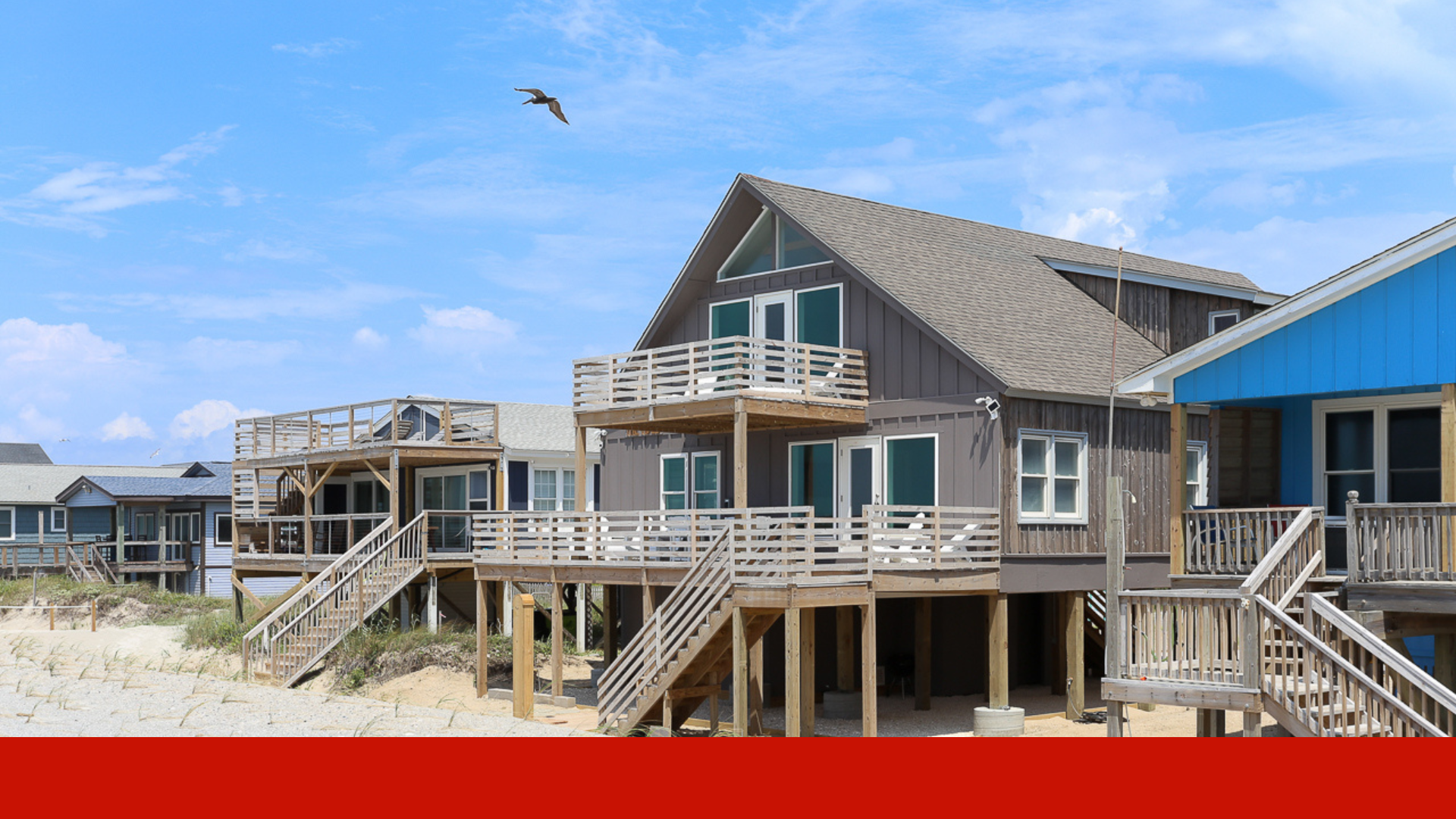
I drive down to Oak Island from Holly Springs more weekends than I probably should admit. I bought an oceanfront house here in 2022, and the truth is that owning a place at the beach taught me more about coastal real estate than fifteen years of selling homes in the Triangle ever did. There’s a difference between knowing the rules on paper and learning them while you’re standing on your own deck wondering why the dune line moved.
So this isn’t a brochure. This is the conversation I have with friends who call me and say, “We think we want a place at the beach. Where do we even start?” I’ll tell you what’s wonderful about Oak Island, what locals genuinely love about living here, and the handful of things that quietly make or break a beach purchase down here. Some of those factors can become costly mistakes if you don’t know what to look for.
Oak Island is not Myrtle Beach, and that’s exactly the point
If you’ve only ever done the high-rise, neon, mini-golf version of the beach, Oak Island is going to feel different in the best way. It’s a working, lived-in island. Families have owned the same cottages for three generations. You’ll see golf carts puttering to the pier at sunset and kids hauling boogie boards across the road without a care. There’s no boardwalk carnival. The pace is slower, the houses are mostly single- family rather than condo towers, and the beach itself runs for miles facing south, which means you get sunrises and sunsets over the water depending on where you stand.
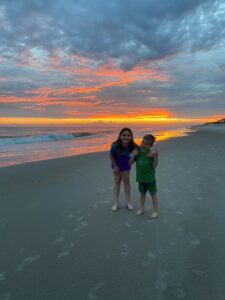
My two on the sand at the end of a good day. This is the whole reason we bought here.
That low-key character is the whole appeal, and it’s also why inventory here behaves differently than it does in flashier beach markets. People hold onto these homes. When the right one comes up, you want to already understand what you’re looking at.
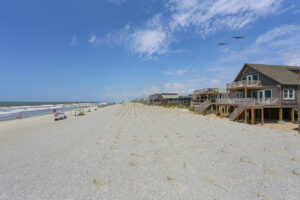
One of the public beach accesses. Those protected dunes in front of the houses aren’t decoration—they’re the island’s first line of defense, and CAMA takes them seriously.
Where I actually eat (bring your appetite)
Half the reason to own here is the food, and I’m happy to be your unofficial guide.
For a real night out, Salt 64 on E. Oak Island Drive is my answer. Chef Jon Spencer opened it in 2022—same year I bought my place, so we’ve sort of grown up on the island together—and he leans
into aged center-cut steaks and fresh local seafood with a serious cocktail and wine list. It’s the spot I send people to when they’re celebrating a closing.
For something more barefoot, the island is full of easy seafood-and-a-cold-drink places like the shucker- style spots along the main drag, and a few beach bars where your toes are practically in the sand and there’s live music on a summer evening.
Then there’s ice cream, which on Oak Island is its own food group. Lil & John’s Sweetreat makes ultra- premium homemade ice cream on-site using dairy from grass-fed North Carolina cows, and you can taste the difference. Frosty’s is a little time machine—it feels like a 1960s parlor, handmade waffle cones, the works, with a gift shop tucked in. And OKI Scoop Shop & Donuts has gone and started making hot, made-to-order donuts all day, which should honestly be illegal.
Here’s the thing buyers don’t always realize: you are not stuck on the island for dinner. Southport is a short drive away, and it’s one of the prettiest little waterfront towns in the state. When we want a change of scenery, we point the car toward Rusty Hooks Dockside Grill (its full name—people call it the bar and grill, but it’s “Dockside”). It sits right on the Intracoastal Waterway at the South Harbour Village Marina, the Capps family runs it, and their jumbo-lump crab cakes get talked about for a reason. You eat with the boats going by. Southport also has the Provision Company and a stack of other waterfront spots, plus the historic downtown that’s been the backdrop for more than a few movies. Two of my agents love it so much that one of them owns a home over there—and another one owns on Oak Island right alongside me. We are, collectively, very invested in this stretch of coast.
Now the part nobody tells you at the open house
This is where my own ownership earned its keep. A beach house is not a regular house with a better view. There are three things I make sure every buyer understands before they fall in love with a listing.
1. What’s holding the house up: pilings
Most homes here are elevated on pilings, and that’s a feature, not a flaw—lifting the living space up lets storm surge and wave energy pass under the house instead of slamming into it. But pilings are exactly what a standard home inspector can gloss over, so I push for a closer look.
Here’s the part that cost me real money, so listen to this one. A lot of older island homes were built on what are essentially treated telephone poles, and those tend to last around 40 years. The cruel trick is that a piling can look completely solid above the sand—straight, painted, supportive—and be rotted through below grade where you can’t see it. When we dug out the pilings on the home I bought, this is what was waiting underneath:
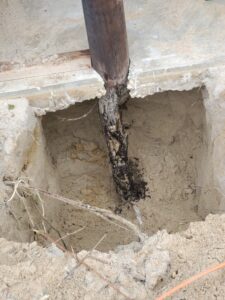
Same piling, above and below the sand line. Solid up top, eaten through underneath. You don’t find this without digging.
We ended up replacing them at roughly $5,000 per piling—about $70,000 in total—and when we did, we upgraded to helical piers, which screw down into more stable soil and don’t rot the way wood does.
I’m not telling you this to scare you off a beautiful older cottage. I’m telling you so you build it into your offer and your budget instead of finding out the hard way. On any home with original wood pilings, I want a structural look below grade, not just a glance from the driveway.
You also want someone checking for splitting, settlement, and salt-air corrosion on the connectors and fasteners. If the home sits in a V or VE flood zone (the high-hazard coastal zones where breaking waves are expected), there are real rules about what can go on underneath. The ground-level area can only be enclosed with breakaway walls, lattice, or screening designed to give way in a storm without taking the foundation with it. What you don’t want to discover after closing is that a previous owner quietly finished out that downstairs space into “bonus” living area with wiring and plumbing. That’s a compliance and insurance problem waiting to happen, and I’ve watched it derail deals at the eleventh hour.
2. The rules that decide what you can build: CAMA
North Carolina’s Coastal Area Management Act (CAMA) governs development along the oceanfront, and it has more teeth than people expect. The state designates “Areas of Environmental Concern,” and oceanfront construction has to sit a certain distance back from the line of stable natural vegetation—the setback. For a typical single-family home that starts around 60 feet landward of the more restrictive vegetation or pre-project line, and it gets larger for bigger houses.
Oak Island specifically saw a rule change take effect in 2022 that repealed the old “development line” and reverted to a more conservative reference line for measuring those setbacks. Translation: the buildable envelope on some oceanfront lots is tighter than the lot size alone would suggest. North Carolina also prohibits hardened structures like seawalls and groins on the oceanfront, because they ultimately destroy the public beach.
The piece that surprises people most: if a storm destroys an oceanfront home, you can’t always rebuild it where it stood. You have to meet current setbacks at the time you rebuild, and if the shoreline has migrated, the lot may no longer support the footprint you lost. This is precisely the kind of thing I want a buyer thinking about before they write an offer, not after. The town has a CAMA Local Permit Officer, and on the right deal we’ll loop them in early.
And it isn’t only storms that trigger this. So many buyers fall for an older, “grandfathered” oceanfront ottage and immediately want to gut it and modernize—and you have to do that carefully. North Carolina uses what’s commonly called the 50% rule: if the cost of your repairs or improvements reaches 50% or more of the structure’s market value (just the house—not the land, not the deck, not the furniture), the work is treated as a “substantial improvement.” At that point the whole home generally has to be brought into compliance with current rules, including today’s CAMA setbacks and elevation requirements. On a home that’s already sitting inside the modern setback line, that can mean you’re suddenly looking at relocating the house landward—or that the renovation you dreamed up simply can’t happen as drawn. The building inspector can even require an appraisal and contractor estimates to make the call. The workaround is to plan renovations in phases and know that structure value before you start swinging hammers, which is a conversation we have early and often with our beach buyers.
3. The cost that creeps up on you: flood insurance
Flood insurance is its own subject, and it’s changed a lot. Under FEMA’s Risk Rating 2.0 system, your premium isn’t a flat “you’re in Zone AE” number anymore. It’s priced on your specific
property—distance to water, foundation type, the elevation of the lowest floor relative to the base flood elevation, replacement cost, flood history, all of it. Get the home’s elevation certificate early; it’s one of the biggest levers on what you’ll pay.
Here’s my favorite money-saving tip, and it’s one a lot of agents don’t even bring up: federal flood policies are assumable. If a longtime owner is sitting on an older, lower-priced policy, you can often
take that policy over when you buy the house instead of starting fresh at today’s full-risk rate. On a coastal home that can be the difference between a few hundred dollars a year and a few thousand. I always ask the listing side for the seller’s flood policy declarations page so we can compare the current premium against the full-risk number and see whether assuming it makes sense. It’s also worth shopping private flood carriers against the federal program, because in some lower-risk pockets they come in cheaper.
One housekeeping note: the National Flood Insurance Program runs on periodic congressional reauthorization, so when you’re under contract we’ll confirm the program is active and your binder is in order before closing. And budget separately for wind/hail and named-storm coverage—that’s not the same thing as flood, and coastal deductibles work differently.
A quick word on renting it out
A lot of my buyers want the house to earn its keep when they’re not there, and Oak Island’s family- friendly reputation makes it a steady vacation-rental market. Investment real estate is a big part of what my team does, so if your plan is part beach house, part income property, we can run realistic rental numbers, factor in the insurance and maintenance reality of a coastal home, and tell you honestly whether the math works. Salt air is hard on everything—fasteners, HVAC, decking—so the maintenance line in your budget should be a little higher than you’d guess inland.
Why work with us
Plenty of agents can unlock a door and write an offer. What you want at the beach is someone who has personally signed a CAMA acknowledgment, sweated over their own elevation certificate, and called the town with a piling question on a Saturday. That’s me, and that’s my team—I own oceanfront here, one of my agents owns on Oak Island, and another owns over in Southport. We know this coast because we live on it. Team Anderson Realty is a boutique firm with a “World Class Service” approach, and we’ve closed hundreds of homes for buyers, sellers, and investors across the Carolinas. Whether you’re hunting for your first Oak Island cottage, eyeing an oceanfront place like mine, or ready to sell the one you’ve got, I’d love to help.
Call or text: (919) 610-5126
TeamAndersonRealty.com · Tell me what you’re dreaming about. I’ll tell you where to get the ice cream.
Frequently Asked Questions
Do you need flood insurance to buy a house on Oak Island, NC?
If you finance the home with a federally backed mortgage and it sits in a designated high-risk flood zone, your lender will require flood insurance. Even outside those zones, it’s strongly recommended on a barrier island. Premiums are now priced property-by-property under FEMA’s Risk Rating 2.0, so two neighboring homes can pay very different rates.
What is a CAMA setback on Oak Island?
It’s the minimum distance an oceanfront structure must sit back from the line of stable natural vegetation under North Carolina’s Coastal Area Management Act. For a typical single-family home it begins around 60 feet and increases for larger structures. A 2022 rule change made Oak Island’s reference line more conservative, which can shrink the buildable area on some oceanfront lots.
Can you rebuild an oceanfront home on Oak Island if a storm destroys it?
Not automatically. To rebuild you must meet the CAMA setback rules in effect at that time. If the shoreline has eroded landward, the lot may no longer support the original footprint, and in some cases owners are told they cannot rebuild as before. This is a key thing to evaluate before buying oceanfront.
Are Oak Island beach houses on pilings safe?
Yes—elevating a home on pilings is a proven coastal design that lets storm surge and waves pass beneath the living space. The important step is a thorough inspection of the pilings, connectors, and any below-elevation enclosures, plus confirming that ground-level areas comply with V-zone rules (breakaway walls or lattice only, no unpermitted finished living space).
How long do wood pilings last, and how do you know if they’re bad?
Older homes were often built on treated wood pilings (sometimes essentially telephone poles) that tend to last around 40 years. The danger is that a piling can look perfectly sound above the sand and be badly rotted below grade. The only way to know is to inspect below the surface; when pilings fail, owners often replace them—roughly $5,000 each in our experience—and many upgrade to helical piers, which resist rot.
Can you renovate an older “grandfathered” oceanfront home on Oak Island?
Yes, but cautiously. Under the 50% rule, once repairs or improvements reach 50% or more of the structure’s market value (not the land), the work is considered a substantial improvement and the home generally must meet current CAMA setbacks and elevation requirements—which can force relocation or limit what you can do. Confirm the structure’s value and your renovation plan with the local permit officer before you begin.
How far is Southport from Oak Island?
Southport is just a short drive from Oak Island, making it easy to spend an afternoon at waterfront spots like Rusty Hooks Dockside Grill on the Intracoastal Waterway or to explore the historic downtown. Many buyers love that they get an island beach and a charming coastal town within minutes of each other.
What’s a good restaurant on Oak Island?
For a special dinner, Salt 64 is a local favorite for steaks and fresh seafood. For ice cream, locals point to
Lil & John’s Sweetreat, Frosty’s, and OKI Scoop Shop & Donuts.